Oncall Bot and Frontend Monitoring
Relative-change alerting on ClickHouse telemetry plus an LLM-assisted chat bot that turns an alert into a probable root cause, in the thread where the team already works.
- Role
- Senior Frontend Engineer
- Period
- 2025–present
- Stack
- ClickHouse · Alerting service · LLM API · Kubernetes · Internal chat bot
The problem
Silent drop-offs during third-party handoffs, such as NFC checks, were found days later through customer support. Our alerts were threshold-based and noisy, so people had learned to ignore them.
The approach
- Relative baselines, not static thresholds. The alerting service runs SQL against ClickHouse and compares each metric with the same hour last week. A 20% conversion drop means something at 3 a.m. in Tokyo and at noon in Berlin, and global traffic swings stop causing false alarms.
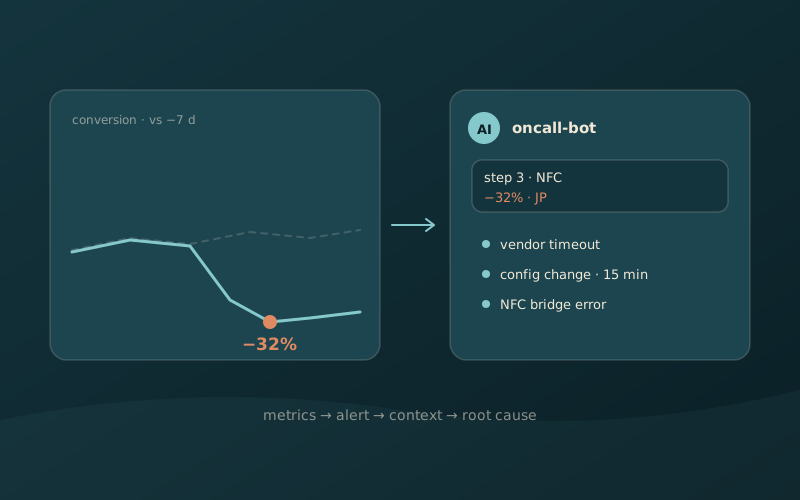
- An alert that arrives with context. When an alert fires it posts an incident card to the internal chat platform. A background worker then gathers recent frontend error stack traces from ClickHouse, the active config version from the configuration service and Kubernetes deployment logs, and sends them as a structured prompt to an enterprise LLM API.
- A summary in the thread. The bot replies with a probable root cause, for example: step 3 conversion down 32% in Japan, a null-pointer error in the NFC bridge wrapper, a config change deployed 15 minutes earlier and a vendor gateway timing out on the backend.
The result
Time to detect dropped from hours or days to under 5 minutes, time to mitigation fell by 65% and false-positive alerts by 80%. I also tracked alert signal-to-noise (the share of alerts that map to real incidents) and mean time between failures for frontend modules.
Why this way
A normal alert tells you something broke. Collecting the data automatically and summarizing it closes the gap between a metric and a person understanding it, which is where most of the response time was going.